
Professional Roles, Skills, and Career Paths in Data & AI: An Industry Perspective
Date:
On November 26th, I had the privilege of returning to my alma mater, the Universidad Politécnica de Cartagena (UPCT), to deliver a guest lecture to final-year students in the Data Science degree program. The session focused on “Professional Roles, Skills, and Career Paths in Data & AI: An Industry Perspective” - sharing real-world insights about the data industry and helping students navigate their upcoming transition from academia to professional practice.
I’m deeply grateful to Professor Alejandro Martínez Sala, who was my professor during my time at UPCT, for extending this invitation. Having him as a teacher years ago and now returning at his invitation to share my professional experience with his current students made this occasion especially meaningful.
Closing the circle: giving the talk I wish I had received
There’s something profoundly meaningful about returning to the university where your journey began, now with years of industry experience, to share insights with students who are exactly where you once stood. This experience represents what I call “closing the circle” - the opportunity to provide the guidance and realistic perspective I wish I had received as a student.
When I was in their position, about to graduate and enter the professional world, I had many questions that weren’t fully addressed in traditional academic settings: What do data professionals actually do day-to-day? How do I choose between different career paths? What skills really matter in industry? How different is the real world from what we learn in university?
Now, having worked over 8 years across Spain and the UK, navigating different roles, company sizes, and challenges, I had the opportunity to answer these questions for the next generation. It’s not just about sharing knowledge - it’s about helping students avoid common pitfalls, set realistic expectations, and make informed decisions about their careers. This is the talk I would have loved to attend as a student, and being able to deliver it felt like completing an important cycle.
The real landscape of data work
One of the core themes of my presentation was bridging the gap between academic expectations and industry reality. Universities excel at teaching fundamental concepts, algorithms, and theoretical frameworks. However, the day-to-day work in data and AI often looks quite different from classroom exercises.
The reality that students need to know:
Fragmented data infrastructure: In many organizations, especially SMEs, data is scattered across multiple systems without clear integration or governance policies. Your first job might involve more data wrangling than model building.
Unclear responsibilities: Role definitions vary wildly across companies. A “Data Scientist” at one company might do completely different work than at another. Company size, industry, and organizational maturity all influence what your actual responsibilities will be.
Leadership overwhelm: Many business leaders feel overwhelmed by the complexity of data tools and possibilities. Part of your role will be translating technical capabilities into business value and helping stakeholders navigate choices.
The messy middle: Between the clean datasets of university projects and the polished case studies in blog posts lies the messy reality: incomplete data, changing requirements, legacy systems, and the constant need to balance technical ideals with practical constraints.
I wanted students to understand this not to discourage them, but to prepare them. Knowing these realities upfront helps you ask better questions during interviews, set appropriate expectations, and develop the right skills.
Key roles in Data & AI
The presentation covered the main professional roles students might encounter:
Technical roles:
- Data Engineer / Data Architect / DataOps: Building and maintaining data infrastructure, pipelines, and ensuring data quality and availability
- Analytics Engineer / Data Analyst / Business Intelligence Expert: Transforming data into insights, building dashboards, and supporting business decisions
- Data Scientist / Machine Learning Engineer / MLOps: Developing predictive models, deploying ML systems, and maintaining production ML infrastructure
- AI Engineer (LLMs, agents): Working with large language models, building AI agents, and implementing generative AI solutions
Business-oriented roles:
- Analytics Translator / Data Product Manager: Bridging business needs and technical solutions, defining product strategy
- Head of Data / Chief Data Officer: Strategic leadership, data governance, team building, and organizational transformation
An important insight I shared: every company calls these roles something different, and they often overlap. Don’t get too hung up on job titles - focus on understanding what the actual work involves and whether it aligns with your interests and strengths.
Skills that actually matter
Beyond technical competencies like Python, SQL, cloud platforms, and machine learning frameworks, I emphasized the critical importance of non-technical skills:
Communication:
The ability to explain complex technical concepts to non-technical stakeholders is often more valuable than advanced modeling skills. If you can’t communicate why your work matters, it won’t have impact.
Business acumen:
Understanding how businesses operate, what drives value, and how to connect data work to organizational goals is essential. The best technical solution that doesn’t align with business needs is worthless.
Experimentation mindset:
Comfort with uncertainty, willingness to test hypotheses, and ability to learn from failure are crucial in an evolving field where best practices are constantly changing.
Key lessons from my journey
I shared the most important lessons I’ve learned over my career - insights that came from real projects, mistakes, and successes:
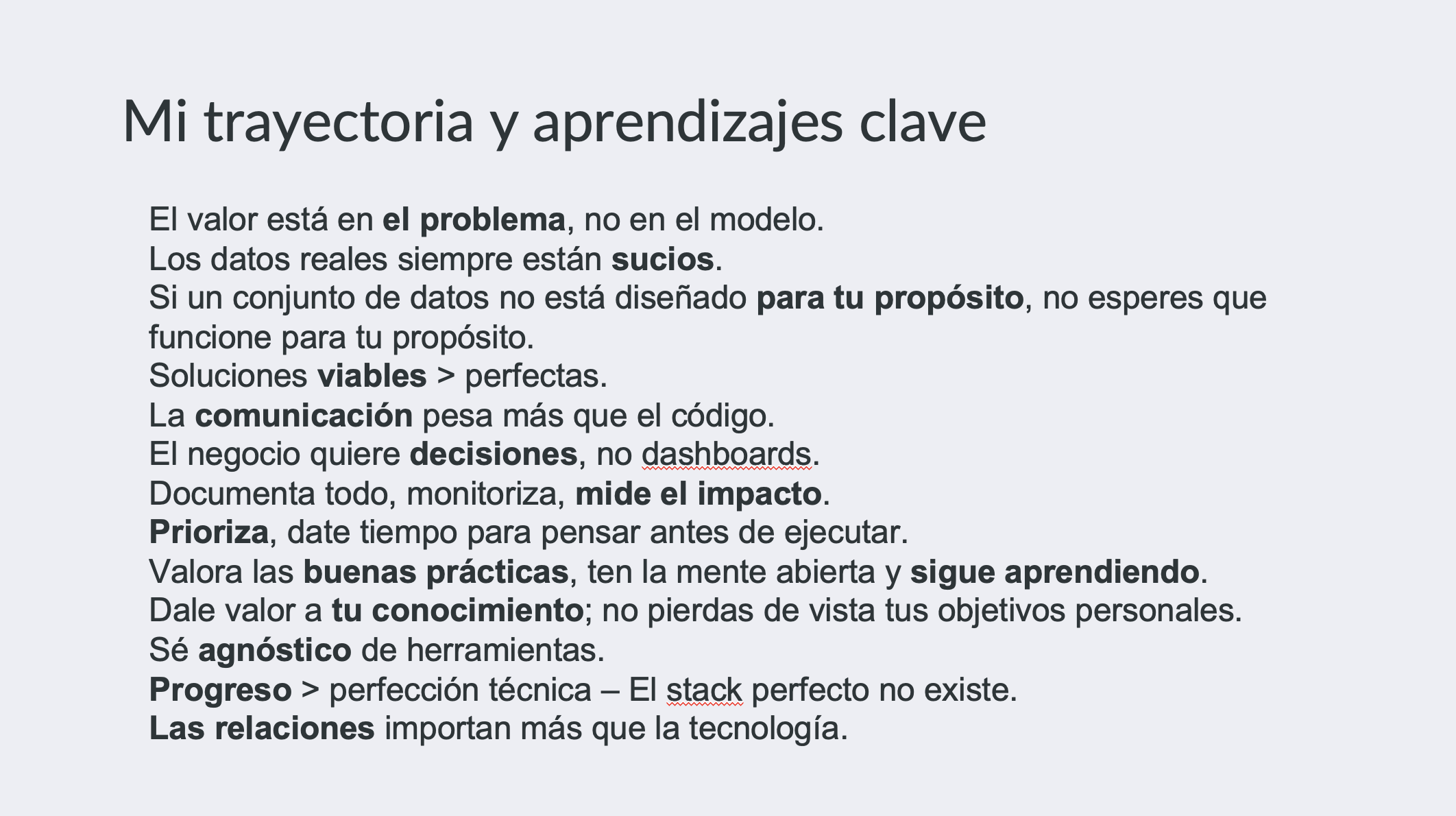
The value is in the problem, not the model: Fancy algorithms don’t matter if you’re solving the wrong problem. Always start by deeply understanding the business challenge.
Real data is always messy: Perfect, clean datasets don’t exist outside of classrooms. Learn to work with imperfect information.
If a dataset wasn’t designed for your purpose, don’t expect it to work for your purpose: You can’t force data to answer questions it wasn’t collected to answer. Sometimes you need to collect new data.
Viable solutions > perfect solutions: In business, a 70% solution delivered on time beats a 95% solution that arrives too late. Learn when good enough is truly good enough.
Communication weighs more than code: Your ability to influence decisions and drive action through clear communication will determine your impact more than your technical prowess.
Business wants decisions, not dashboards: Insights without recommendations don’t create value. Always connect analysis to actionable next steps.
Document everything, monitor, measure impact: If you can’t measure the impact of your work, you can’t demonstrate value or learn what actually works.
Prioritize, give yourself time to think before executing: Rushing to code without planning is a recipe for wasted effort. Think first, then execute.
Value good practices, keep an open mind, keep learning: The field evolves rapidly. Maintain strong fundamentals while staying curious about new approaches.
Value your knowledge; don’t lose sight of your personal goals: Your skills have worth. Make sure your career path aligns with what you want from life, not just what others expect.
Be tool-agnostic: Technologies come and go. Focus on understanding principles that transcend specific tools.
Progress > technical perfection: The perfect stack doesn’t exist. Ship working solutions and iterate based on real feedback.
Relationships matter more than technology: Your network, your ability to collaborate, and the trust you build with colleagues will open more doors than any technical skill alone.
Choosing your career path
I guided students through thinking about three main directions their careers could take:
Engineering path:
Focus on building robust, scalable systems. If you love infrastructure, pipelines, and ensuring things work reliably at scale, this might be your path.
Business path:
Bridge technical and strategic thinking. If you enjoy understanding business problems and translating them into data solutions, consider roles closer to business stakeholders.
Research path:
Push boundaries of what’s possible. If you’re fascinated by unsolved problems and want to contribute to advancing the field, consider research-oriented roles or pursuing advanced degrees.
I encouraged students to:
- Reflect on their personal preferences and strengths - what energizes vs. drains them
- Build a useful portfolio that demonstrates both technical skills and problem-solving ability
- Seek diverse experiences early in their career to discover what resonates
My research project: bridging academia and industry
I also shared my current Industrial PhD research at the Universitat Oberta de Catalunya, which addresses the question:
“How can Explainable AI support strategic decision-making in SMEs, fostering resilience, competitiveness, and adaptability under resource constraints?”
This allowed me to illustrate that the learning journey doesn’t end with your degree - many professionals return to research after gaining industry experience, bringing practical insights that enrich academic work. The Industrial PhD program represents a powerful model for bridging academic rigor with real-world impact.
Final thoughts
The session was highly interactive, with students asking thoughtful questions about specific career scenarios, technical choices, and how to prepare for their job search. Their engagement reminded me why experiences like this matter so much.
Closing the circle isn’t just about giving back - it’s about participating in a continuous cycle of learning and growth. The students taught me as much through their questions and perspectives as I hopefully shared with them. They challenged me to articulate things I’d learned implicitly, reminded me of the excitement and anxiety of starting out, and reinforced my commitment to making data and AI work more accessible and impactful.
To any student reading this: the transition from university to industry can feel daunting, but remember that everyone started where you are now. Focus on continuous learning, stay curious, build genuine relationships, and don’t be afraid to ask questions. The data and AI field needs diverse perspectives and fresh thinking - your contribution matters.
And to my fellow professionals: I encourage you to find opportunities to close your own circles. Whether through guest lectures, mentoring, or simply sharing your experiences, your insights can make a real difference for those just starting their journeys.
Presentation slides: Download PDF
Contact: For students interested in discussing career paths, internships, or research opportunities, feel free to reach out via LinkedIn or email at ginesmoli@uoc.edu
Related: This experience connects to my broader commitment to making data-driven decision-making accessible, which is the focus of my Industrial PhD research on Evaluative AI.