
When research transforms business: experiences from industrial PhDs
Date:
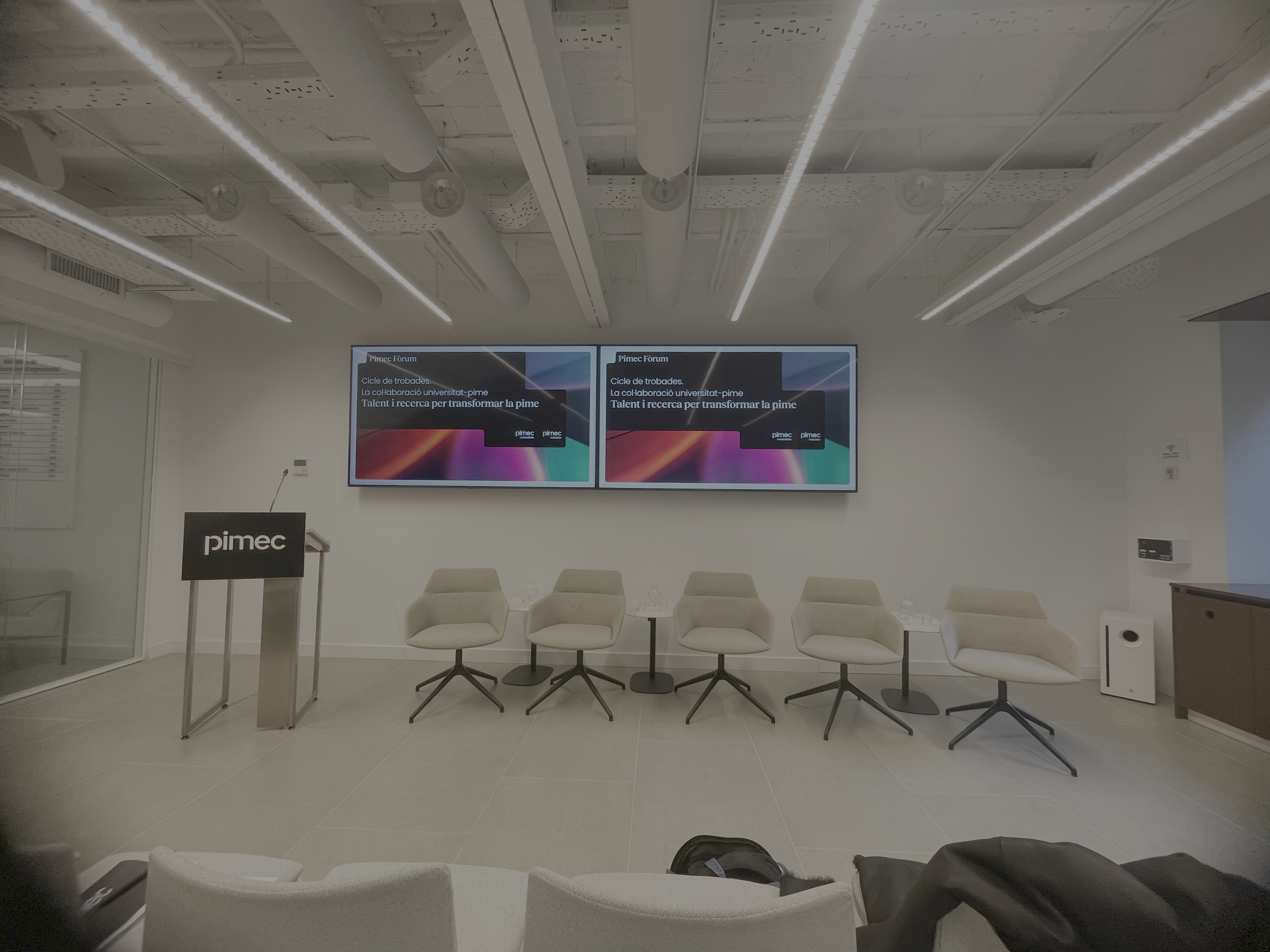
On November 19th, I had the honor of participating in a round table organized by PIMEC about the impact of industrial PhDs on small and medium-sized enterprises. The event brought together academics, entrepreneurs, and doctoral students to discuss how university-business collaboration can transform SMEs through applied research and knowledge transfer.
.jpg)
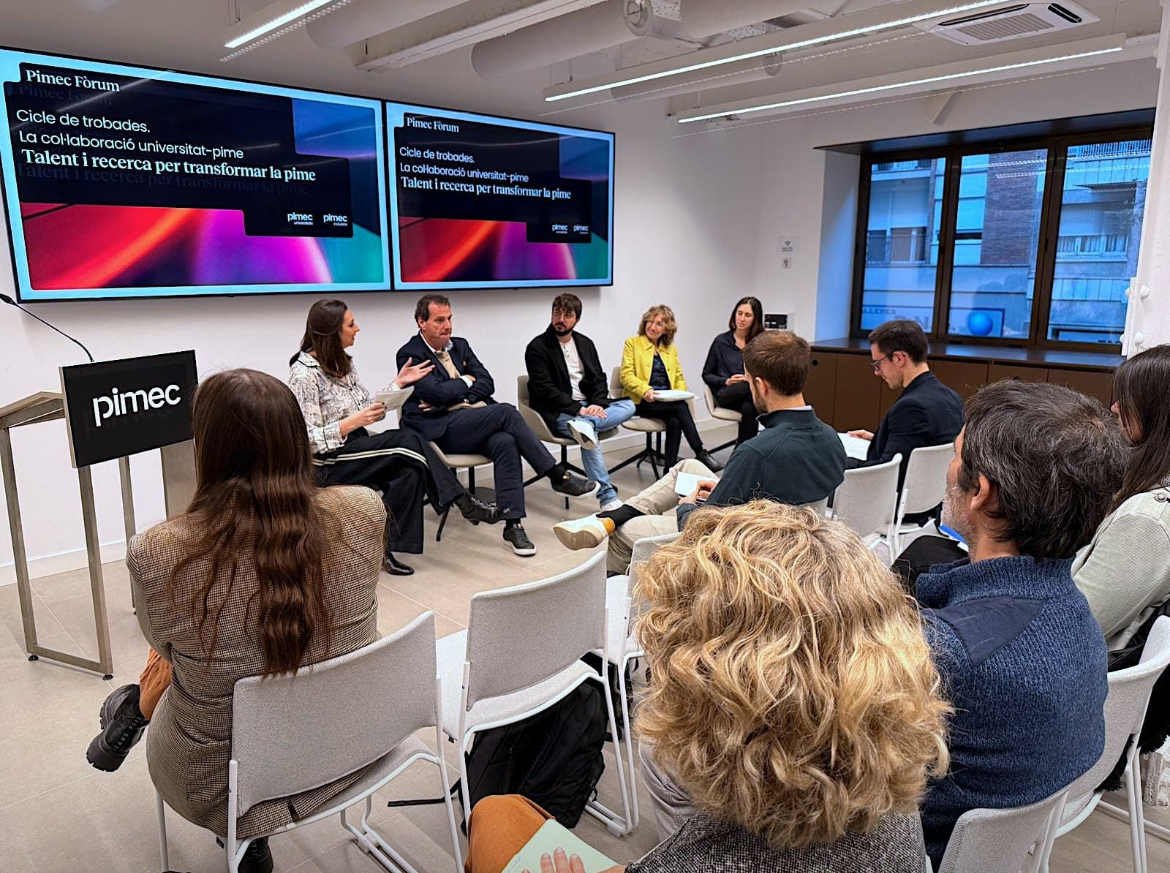
The value of industrial PhDs for SMEs
For a company, investing in an industrial PhD is an act of courage, as it involves opening space for a different way of working: more reflective, more rigorous, and more long-term oriented. In my case, this investment has been especially valuable both for the company and for me as a professional. It is allowing me to connect the real strategic challenges of an SME with advanced data tools, generative artificial intelligence, and decision models.
Transforming business innovation
This is transforming the company’s innovation: we no longer work only from intuition, but from formal frameworks, intelligent agents, and optimization processes that align decisions with strategic objectives and organizational resilience.
The added value has been twofold:
- Hypothesis clarification: We have been able to convert diffuse questions into clear and testable hypotheses
- Decision support systems: We have built systems that help the company think better, decide better, and anticipate better
This is something that normally an SME cannot develop alone, neither due to time nor technical capacity. For my professional development, it is also a satisfying investment, since in addition to working at the forefront of the latest technologies, I have the fortune of being able to apply it to a real use case, offering me a lot of learning and skills and capabilities that companies are also demanding.
Obstacles and how to overcome them
The path has not been without obstacles. The most evident has been balancing two logics that sometimes clash: the urgency of the company and the rigor of academia. Moreover, when research is innovative and applies generative AI or multi-agent architectures, you don’t always find a collaborative environment.
Overcoming strategies
To overcome these challenges, I have relied on:
- External networks: Collaboration with other researchers and professionals
- Healthy collaboration: Establishing common spaces for cooperation
- Incremental value: Delivering small successes that consolidate trust and demonstrate impact
This challenge has forced me to explain the same problem from different perspectives and to establish common spaces for cooperation, which is key for knowledge transfer.
Panel participants
The round table featured the participation of:
- Mr. Joan Torrent - Professor at UOC and Director of the Research Unit on Management and Governance at UOC
- Mr. Ginés Molina-Abril - Data Optimization & Innovation Engineer
- Ms. Coloma Ballester - Director of the UPF Doctoral School
- Ms. Laura Portell - Industrial PhD candidate at UPC-Municipal Institute for People with Disabilities
Moderator: Ms. M. Àngels Benítez - Head of Social Policies and Labor Inclusion at PIMEC
Final reflection
Industrial PhDs transform companies because they bring a more rigorous way of thinking about problems and a bolder way of solving them.
This experience not only creates value for the company and the doctoral student, but also contributes to building a stronger ecosystem of university-business collaboration that can be crucial for the competitiveness of Catalan and Spanish SMEs in an increasingly technological and dynamic environment.
Related to my industrial PhD: This work is part of my Industrial PhD at the Universitat Oberta de Catalunya (UOC) within the Industrial Doctorates program of the Generalitat de Catalunya, where I research evaluative AI frameworks for strategic decision-making in SMEs.
Related publication: Towards an Evaluative AI Framework for Hypothesis-Driven Strategic Decision-Making in SMEs